
Custom Taekwondo Forearm Guards: Lightweight, Flexible Arm Protection for Sparring, Training and Competition
In Taekwondo sparring, the forearms do a lot of quiet work: they block kicks, intercept strikes and absorb contact all day long. Wani Wear manufactures Custom Taekwondo Forearm Guards that protect the arm from elbow to wrist while staying light and flexible enough for fast blocking and quick movement. We supply dojangs, clubs, private label brands and distributors in the USA, UK, Europe, Australia and Turkey.
What you get
What you customize
Our guards are made in Sialkot, Pakistan, where sports equipment has been produced for generations. Because we are a direct factory, you control the specification and we prepare free mockups before production. Orders start under our low MOQ program from 10 pieces, and qualifying custom orders ship with free worldwide shipping. We describe our guards as WT-style protective equipment for training and sparring unless a product has been officially approved. Every order is made at our own facility, so communication stays fast and quality stays consistent, and our checks cover shape, foam, stitching and strap strength on every batch. Samples are welcome before a full production run, and reorders follow your approved specification. Tell us your target athletes and price level in your first message and we will recommend a shell, foam and strap combination to match.
Build the full sparring set with Taekwondo Shin Guards, Chest Protectors, Headgear and Groin Guards, or match everything with Taekwondo Doboks.
Need custom forearm guards for your dojang or brand? Ask for a free mockup.
The Most Neglected Piece of Sparring Gear
Ask a Taekwondo student which protective item they would leave at home, and the forearm guard is often at the top of the list. It is small, it hides under the dobok sleeve and it does not feel as important as a chest protector or headgear. Ask the same student after a hard sparring class without one, and the answer changes. Forearms collect the bruises that come from blocking roundhouse kicks, catching strikes and clashing with an opponent’s arms and shins.
Wani Wear manufactures Custom Taekwondo Forearm Guards as part of a full sparring range. We are a direct manufacturer in Sialkot, Pakistan, the long-established center of sports equipment production, and we make these guards for business buyers: school owners, club suppliers, private label brands and distributors who serve several countries.
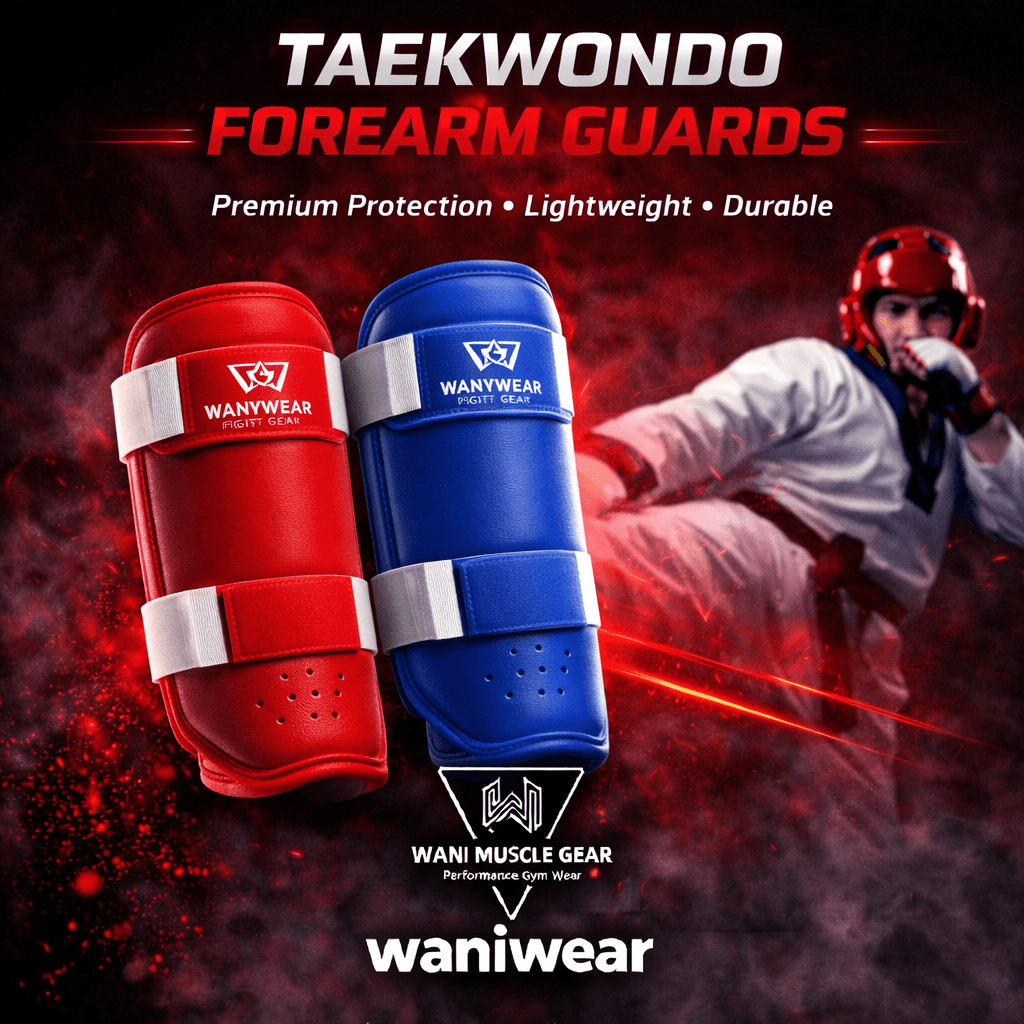
This page is a practical buying guide. It explains how our forearm guards are built, which styles we make, how fit and sizing work, how men’s, women’s and youth versions differ, and how ordering runs from first inquiry to delivery.
What a Forearm Guard Protects
The best guards follow the natural curve of the arm. A flat, rigid guard rotates and gaps, while a preformed guard sits close, moves with the arm and keeps the padding where contact happens.
Forearm Guard Styles We Manufacture
Classic WT-Style Guard
A preformed, shaped guard with a smooth PU cover, foam core and two adjustable elastic straps. The standard choice for most sparring classes and competition-minded athletes.
Extended Coverage Guard
A wider or longer guard that covers more of the forearm. Popular with athletes who want extra protection and with schools that spar at heavier contact.
Slip-On Sleeve Guard
A stretch sleeve with built-in foam padding. Easy to put on, comfortable and popular for beginners and young students.
Youth Guard
A smaller, lighter version with soft foam and simple straps that children can fasten on their own.
Most buyers start with the classic guard in two colors, add a youth size and later introduce an extended or sleeve style for specific customer groups.
Anatomy of a Wani Wear Forearm Guard
Materials at a Glance
We can adjust foam thickness, cover finish and strap design to match your price level. If you already sell a guard your customers like, send a sample and we will match its feel or suggest improvements.
Men’s, Women’s and Youth Forearm Guards
Taekwondo is trained by people of every age and build, and forearms vary a lot in length and thickness. A good range therefore includes more than one pattern.
Men’s and Adult Guards
Adult men’s guards use a longer, wider pattern with thicker foam, designed for stronger contact and larger forearms. They are normally the highest-volume items in a school catalog.
Women’s Guards
Women’s guards use a slimmer pattern with a narrower shell and shorter straps, so the guard sits close without twisting. Many brands also give women’s collections their own color palette. We recommend testing samples on the athletes you plan to sell to.
Youth and Junior Guards
Youth guards are smaller and lighter, with softer foam and simple closures that children can manage alone. Because children grow quickly, youth guards are reordered often in school and club programs, and a small first order is a good way to test sizes and colors.
Fit Guide: Do and Do Not
Do
Do not
We recommend printing a short fit instruction on your packaging. It reduces returns and helps students wear the guard correctly from day one.
Reference Size Guide
Forearm guards are sized by forearm length, from just below the elbow to the wrist, with width graded to match. The guide below is only a general idea. The final size and pattern will always be whatever the customer provides and confirms with us before production.
*Note: these measurements are approximate and serve only as a general reference. The final guard length, width, foam thickness and strap length will be exactly what the customer specifies and confirms in writing (size grid, measurements, sample or tech pack) before production begins. Men’s, women’s and youth sizes can each be graded to your own specification. You can also compare with our general Wani Wear size chart.
Colors, Logos and Branding
Many schools like white or light guards that sit almost invisibly under the dobok sleeve, while brands and teams often prefer bold black and red or other color combinations. We support both approaches.
- Color options: white, black, red, blue and custom two-tone combinations in your brand colors.
- Logo application: printing, embossing or embroidery on the cover or strap.
- Labels and tags: woven labels, printed size tags, care labels and hangtags.
- Packaging: pair bags, mesh bags or retail boxes, with fit instructions in your language.
- Matching sets: coordinate colors and logos with shin guards, chest protectors, headgear and groin guards.
Our Custom Design Support team prepares free mockups with unlimited revisions, and our OEM and private label service covers labels and packaging for brands.
Rules, Approvals and Honest Descriptions
Taekwondo competitions are run by federations and event organizers, and each sets its own equipment rules. World Taekwondo (WT) events, for example, work from approved equipment lists, and approval marks are granted through the federation’s own process. A guard that looks like an approved guard is not automatically approved.
- Decide your purpose: a general training and sparring guard, or a competition guard that needs approval.
- Check current rules: approval lists change, so confirm with the federation or event you sell to.
- Tell us early: if you need a specific design, color or marking, share it at the start.
- Describe the product accurately: we describe our guards as WT-style unless a product has been approved, and we suggest you do the same.
- Avoid safety promises: guards help absorb impact but cannot guarantee that an athlete will not be injured.
From Inquiry to Delivery
Orders start from 10 pieces under our low MOQ program, enough to test a color or add a youth size. Free worldwide shipping applies to custom orders of 10 or more pieces, with standard delivery in 12 to 15 working days via DHL, UPS or FedEx. An urgent 7 to 8 day option is available for a small per-piece charge. Production time depends on quantity and design and is confirmed in your quotation.
Quality Control Before Shipping
- Shape check: the curve of each guard is compared with the approved sample.
- Foam check: padding thickness and firmness are checked for consistency.
- Stitching and binding: seams, edges and strap anchors are tested for strength.
- Strap test: elastic and hook-and-loop closures are checked for secure fastening.
- Print and logo review: branding is compared with the approved mockup.
- Final count and packing: cartons are labeled by size and color for easy receiving.
Selling Forearm Guards in the USA, UK, Europe, Australia and Turkey
- USA: commercial dojangs and competitive clubs buy sparring sets. Bundles and matched colors work well online.
- UK: clubs often buy through one supplier, so reliable sizing and repeat availability matter. Shoppers often type “arm guard” or “forearm protector.”
- Europe: strong federation culture, so check approval requirements and use packaging in local languages.
- Australia: year-round training, so lightweight, breathable guards and easy-clean covers are good selling points.
- Turkey: a strong Taekwondo nation where clubs and brands often build full private label sets.
Care Instructions for Your Customers
- Wipe the cover and lining with a damp cloth and mild soap after training.
- Air-dry the guard away from direct heat and sunlight, with the straps open.
- Do not machine-wash or soak the foam core.
- Store flat or hanging in a ventilated bag, not damp at the bottom of a kit bag.
- Replace guards with torn stitching, flattened foam or straps that no longer hold.
A ventilated gym bag helps guards dry between classes, and our sports bags can match your guard colors.
Selling Tips for Dojangs and Brands
- Sell in pairs and sets: two guards in a pair bag, or guards bundled with shin guards, raise order value.
- Show the guard on an arm: photos of a guard worn on a forearm show fit better than flat shots.
- Add a size guide: include forearm length and a note on how to measure.
- Be clear about approval: state whether a guard is WT-style or officially approved.
- Offer youth sizes: junior programs drive repeat orders.
Common Mistakes When Sourcing Forearm Guards
- Choosing flat, unshaped guards: they slide and gap. Preformed shapes stay in place.
- Skipping the sample: shape, strap grip and padding feel are hard to judge from photos.
- Mislabeling approval: calling a guard approved when it is not can harm your brand and marketplace account.
- Ignoring sizes: most schools need at least three or four sizes.
- Weak straps: a strong guard with weak elastic fails in practice.
Why Taekwondo Schools and Brands Choose Wani Wear
- Direct factory communication: questions about foam, shell shape and straps go straight to the team planning your production.
- Free mockups and revisions: approve the look before production.
- Low MOQ: test a design or serve a small school without a huge first order.
- One supplier for the whole set: forearm guards, shin guards, chest protectors, headgear, groin guards, gloves and doboks can be quoted and branded together.
- Consistent reorders: approved patterns and artwork are kept on record.
If you want to feel the padding and check the fit before a larger order, ask for a sample. Many customers send samples to their instructors and senior students first, collect feedback on comfort and movement, and then confirm small changes before bulk production begins.
Packaging and Labeling Checklist
- Product name, style (men’s, women’s or youth) and size shown clearly.
- Fit and care instructions in the main language of your market.
- Brand name, contact details and country of origin as required by your sales channel.
- A barcode or SKU label placed where your warehouse or retailer expects it.
- Honest wording about what the guard is, without promises of total protection.
- Pair bags or retail boxes that keep both guards together and neat in transit.
How a Forearm Guard Works in Real Sparring
Picture a roundhouse kick meeting a block. The kicker’s shin or instep lands on the defender’s forearm, and for a moment a lot of force is concentrated on a narrow strip of bone and muscle. A guard changes what happens in that moment. The curved shell spreads the force across a wider area, the foam core absorbs part of it, and the soft lining keeps the guard from grinding against the skin.
Three design points decide how well this works. The first is shape, because a guard that follows the arm keeps the padding where contact lands. The second is foam, because padding that is too thin bottoms out and padding that is too thick makes the arm clumsy. The third is the strap system, because a guard that moves at the moment of impact is a guard that fails. We tune all three together when we develop a pattern, and we adjust them for the athlete group you serve.
As with all protective equipment, a guard helps reduce the effects of contact and cannot remove risk. Technique, supervision and sensible intensity remain the foundation of safe training.
Where Forearm Guards Are Worn
- Sparring classes: worn with headgear, chest, groin and shin protection.
- Competition preparation: athletes train in the style of guard they expect to use at events.
- Junior programs: controlled contact drills where students learn blocking and distance.
- Self-defense and conditioning classes: lighter guards are used in some partner drills.
- School events and seminars: schools keep spare guards in several sizes for guests and new students.
Because forearm guards are personal equipment that wear out with use, demand is steady. New students need a first pair, growing students need new sizes, and active students replace worn guards, which makes them a dependable repeat product for school suppliers.
Building a Forearm Guard Range: A Simple Starter Plan
Step 1: Core pair
Launch the classic WT-style guard in white and in black and red. This covers most sparring students.
Step 2: Add youth sizes
Offer XS and S in the same colors so junior programs can buy the whole set from you.
Step 3: Add a second style
Introduce a slip-on sleeve guard for beginners or an extended guard for heavier sparring.
Step 4: Bundle
Offer guards together with shin guards and gloves in matching colors as a ready-made sparring pack.
You do not need to launch everything at once. A small first order lets you see which styles and colors sell, and our low MOQ lets you reorder the winners without carrying excess stock.
School and Club Orders: How to Plan Them
Collect sizes
Choose colors
Approve the mockup
Confirm the list
Receive and distribute
Hygiene Tips for Shared Equipment
Schools often keep loaner guards for beginners and guests. A few simple habits keep shared equipment fresh. Wipe the cover and lining after each class, let guards air-dry fully, rotate pairs so each one has time to dry between uses and replace any guard that smells persistently or looks worn. A printed care card in your packaging makes it easy for coaches to follow the routine.
Replacement Cycles and Seasonal Planning
Foam compresses, straps loosen and covers scuff, so most schools replace forearm guards every year or two, and youth guards more often. Demand often rises before a new term, before major tournaments and ahead of holidays. If you plan promotions such as back-to-school or tournament season, share your timeline early so production and shipping can be planned around it. Our urgent shipping option can help with last-minute restocks, and your approved specification is kept on record so repeat orders match the original.
What Makes a Forearm Guard Comfortable Enough to Keep On?
Students take off equipment that annoys them, and a guard in the gym bag protects nobody. Comfort is therefore a safety feature as much as a selling point. The details that matter most are a smooth inner lining with no rough seams, a shell edge that does not dig into the skin at the elbow or wrist, a strap that holds without pinching, and a weight light enough that the arm does not tire during long rounds. We check each of these when we sample a new pattern, and we ask for feedback from real athletes before the pattern is locked.
Quick Brief Template: What to Send Us
- Style: classic, extended, slip-on sleeve or youth.
- Quantity and sizes: total pairs and the size split for men’s, women’s and youth.
- Colors and artwork: logo files, color references or a description of the look you want.
- Extras: labels, hangtags, pair bags or retail boxes.
- Market and timeline: the country you sell in and any event or launch date.
If you do not have artwork yet, tell us the mood you want, such as clean and minimal or bold and aggressive, and our design team can suggest directions for your approval. We keep you updated by WhatsApp or email from approval to dispatch.
Frequently Asked Questions About Custom Taekwondo Forearm Guards
What is the minimum order quantity?
Orders start from 10 pieces under our low MOQ program, which is enough to test a style, a color or a size.
Are your forearm guards WT-approved?
We make WT-style guards for training and sparring. Official approval comes from the federation, so tell us at the start if you need an approved product and we will discuss what is required.
Do you make youth and women’s sizes?
Yes. We produce men’s, women’s and youth patterns, and every size can be graded to your own measurements.
Can I add my dojang or brand logo?
Yes. We can print, emboss or embroider logos, add woven labels and hangtags, and prepare a free mockup first.
Can you copy a guard I already sell?
Yes. Send a sample or clear photos with measurements and we can match it or recommend improvements.
How long does shipping take?
Standard shipping on custom orders of 10 or more pieces is free and takes 12 to 15 working days. An urgent 7 to 8 day option is available for a small per-piece charge.
Complete the Taekwondo Sparring Set
- Body protection: Taekwondo Chest Protectors, Groin Guards and Shin Guards.
- Head, hands and feet: Taekwondo Headgear, Taekwondo Gloves and Foot Protectors.
- Mouth protection: Custom Mouth Guards.
- Uniforms: Taekwondo Doboks, Karate Gi and Judo Gi.
- Other protection: the full Protection Gear collection.
- Browse more: our Martial Arts department.
Get Your Custom Taekwondo Forearm Guards Quote
Tell us your styles, sizes, colors and logo, and the Wani Wear team will respond with a free mockup and a clear quotation. Direct factory pricing and low MOQs make it simple to supply dojangs, clubs and retailers in the USA, UK, Europe, Australia and Turkey.